What a paradox the Hindu finds himself in! The very scriptures that place Ganga snAnam at the pinnacle of karma also caution that even such a lofty action will not result in the ultimate purushArtha of liberation, if the act is centered on ‘I’ and ‘mine.’ The ego of me doing the act and the fruit that I deserve—these are the traps.
The religion is relentless. It challenges us in the open. While being completely accepting, it is also riddled with intellectual and philosophical paradoxes that push human intelligence. So much so that the seeker eventually finds peace in surrender; and surrender alone.
This is how a simple blind-faith follower equals the wise intellectual seeker—both find their courses ending in surrender. One could even argue that the former is the smarter one because they start with surrender, while the intellectual reaches there after years and lifetimes of failures and ego-struggles
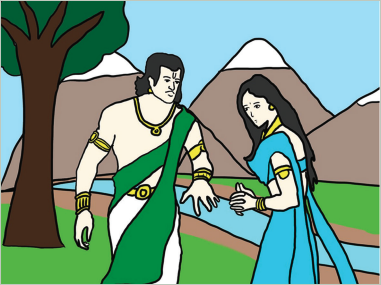
In the Mahabharata, Draupadi and the Pandavas were unfairly banished to the forest for twelve years. During this time, they once found themselves walking along the Himalayan foothills, with the cascading Ganga on their side. Draupadi, yet to be consoled for all the injustices heaped upon them, was seething in anger—directed both at the Kauravas and at her husband Yudhishthira. She lamented, “You keep talking about ‘dharma’ and ‘satya’ as cornerstones of existence, but do you see where it has landed us? We are exiled, not knowing where we will spend the night or what we will eat. Is this homelessness the reward for doing the right thing? How can you justify this?”
Yudhishthira said nothing at first. He simply looked. At the Himalayas, impossibly vast and mighty. At the Ganga, impeccably pure and graceful. Then, quietly, he said, “Do you know why I love these lofty Himalayas, Draupadi? Why my heart leaps up every time I behold the flowing Ganga? Because it is grand. Likewise, Draupadi, dharma is also grand, and so I love it.”
In that moment, Yudhishthira revealed something profound. He didn’t defend dharma by listing its benefits or justifying their own suffering. He simply pointed to its scale—its grandeur—and let that speak for itself. The Himalayas do not ask if we deserve to see them. The Ganga does not calculate who bathes in her. They simply are. And in that ‘being’, they offer something far greater than any transactional reward.
This is a secret our scriptures have been whispering all along.
So, when we ask, “Why should one do Ganga snAnam?”, perhaps we have been framing the question wrong. What if the answer has nothing to do with us at all?
What if, instead of thinking, “I am blessed to do this,” or “I will acquire merits from this dip,” we approached it through factors that do not consume us in ‘I’ and ‘mine’? What if we did it for the love of the scriptures that extol the greatness of Ganga? For the love of Bhagavan from whose feet she originated? For the love of the Guru who encouraged us? To show gratitude to King Bhagiratha, whose penance brought Ganga to earth? As gratitude to the maharishis who took a dip in Ganga to show the way to the world? To reminisce about the incarnations of Bhagavan—Rama, Krishna—who themselves took this sacred dip? Any, and all, of these reasons have nothing to do with the doer or the fruit of the action. They reveal the beauty of Sanatana Dharma—that karma can be done simply for the greatness of the action itself. And only such action can be liberating.
The Vedas tend to speak in coded language; their surface meaning never quite revealing the full story. Veda Mata, in fact, may sound quite stern about the injunctions she offers. For example, she would say that one must perform shrAddha karma properly for one’s ancestors. On the surface, she uses a carrot-and-stick approach to ensure compliance. The stick: if these rituals are not done, subsequent lineages could suffer—genetic disorders, perhaps. When done properly, the departed souls attain benefits and do not suffer in the afterlife. For a believer in the Vedas, this is sufficient instruction. They follow the process.
But is that all the Vedas intend? Not at all. She encourages us to think deeper.
In truth, the Vedas want us to be grateful to our forefathers, for without them, we are nothing. We owe our life to our parents and grandparents. Our genes, our traits, our inheritance, our knowledge, our very looks—everything is owed to them. So, should we not be grateful to them at least once a year, if not always? This is the real intent behind shrAddha karma. But those who mock the rituals, or those who never look deeper, dismiss them without ever finding the inner truths.
The Hindu system encourages us to take that leap and go deep—because without that experiment, the human quest shall forever remain inside the box.
The Himalayas stand. The Ganga flows. The paradox holds. You’re invited—not to solve it, but to stand in its grandeur. Shall we?
Sriram Ramanujam, Houston TX