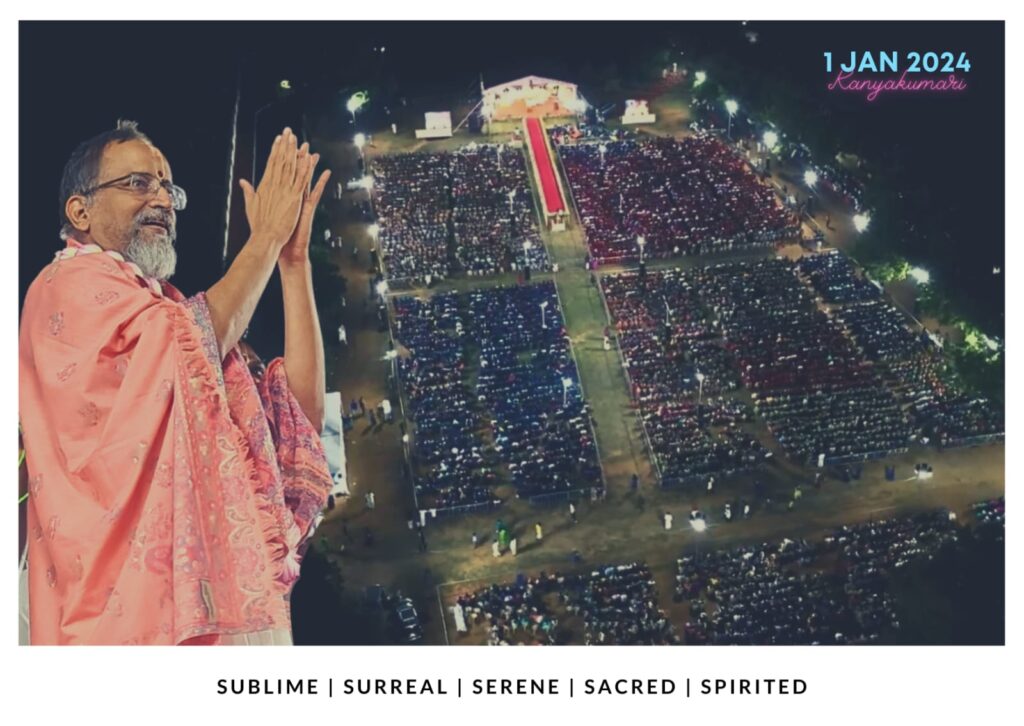
“There is no protection greater than Bhagavan Nama”
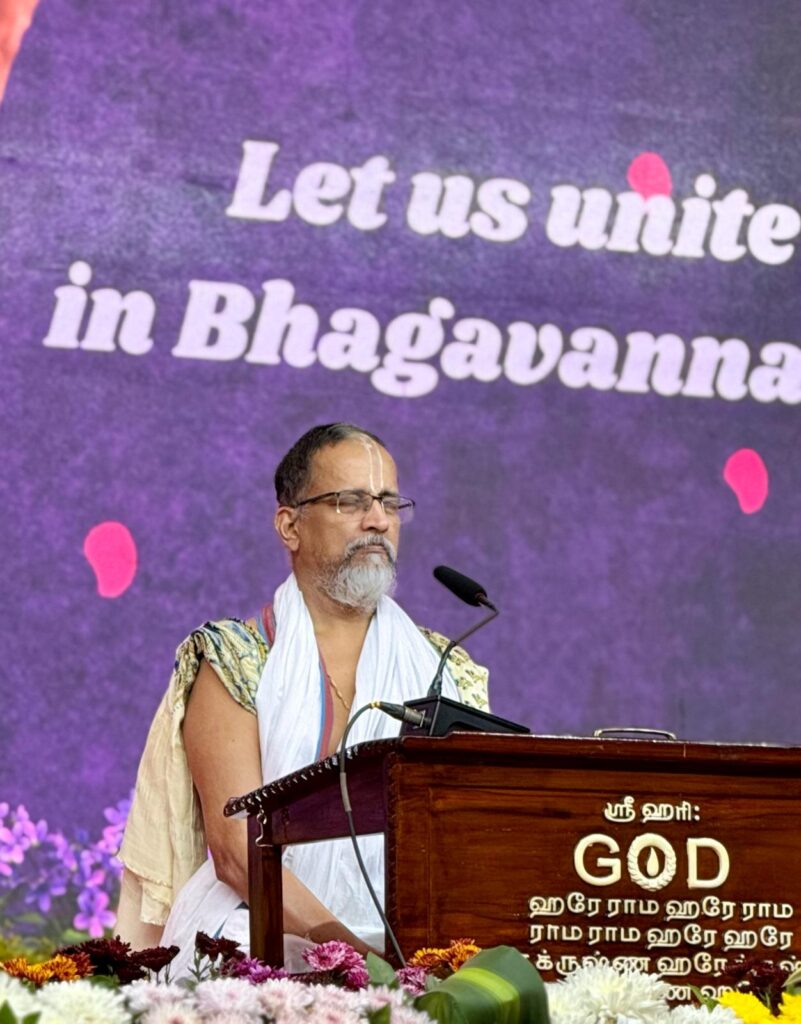
Excerpts from the 20th-year Kalpataru Day Mass Prayer conducted by Sri Swamiji on January 1, 2026, at the Sri Ramachandra Convention Center, Tiruvanmiyur, Chennai.
The Mahamantra Mass Prayer is held every year on Kalpataru Day (Jan 1) to commemorate the blessings showered by Sri Ramakrishna Paramahamsa upon his devotees on this sacred day in 1886. Sri Ramakrishna is revered as an avatara purusha, the divine descent of this yuga. Such exalted beings do not need the study of shastras to acquire wisdom; jnana, bhakti, and vairagya are inherent in them from birth. Sri Chaitanya Mahaprabhu, Sri Adi Sankaracharya, Sri Ramanujacharya, Sri Madhvacharya, Sant Meera Bai and other saints exemplify this truth.
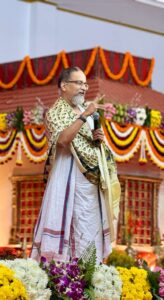 Sri Swamiji explained that some mahatmas attain realization through sadhana (spiritual practice) across many births, completing their spiritual journey in their final janma (birth). Avatara purushas, however, come down to earth in order to establish a path appropriate for the yuga. In the present age, rigorous yoga or tapas is impractical for most; therefore bhakti becomes the primary path, with Nama sankirtan as its foundation. Those who reveal this path are the avatara purushas of this yuga.
Turning to Sri Ramakrishna’s life, Sri Swamiji described how he worshipped Bhavadharini Devi and Radha-Kantha (Sri Krishna) with intense devotion. For him, prayer was not a ritualistic recitation but an open, heartfelt dialogue with Bhagavan. Prayer transcends language and scholarship. Sitting before Devi, he would plead, “Mother! Grant me bhakti, jnana, and vairagya. Take me across this ocean of samsara. To whom else shall I turn?” Sri Swamiji emphasized that speaking one’s heart before Bhagavan is itself bhakti.
Prayer must be free of doubt and calculation. Excessively worrying about prArabdha karma (past deeds), eligibility, homas, or parihAras (ritualistic remedies) only weakens the prayer. True prayer is like the cry of a hungry child—devoid of analysis, filled only with need. We are children of the Universal Father; when our prayer is sincere and childlike, the responsibility to fulfill our need rests with Him. We must do whatever is possible within our limits. Bhagavan cannot be attained by intellect alone, nor by remaining idle. When we strive sincerely within our capacity, Bhagavan completes the rest of the work.
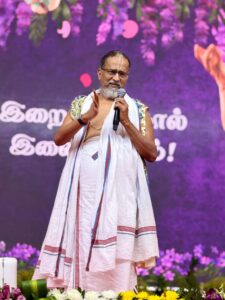 To illustrate this truth, Sri Swamiji narrated the sthala purana of the Sri Sthala Sayana Perumal Temple near Mahabalipuram, one of the 108 Divya Desams. In that kshetra, lived Pundaleeka Maharishi, who followed a simple vow: whatever he perceived as the best, he would first offer to Perumal. If he received a fine silk cloth, his immediate thought was to offer it to Bhagavan.
One day, Pundaleeka Maharishi saw a thousand-petaled lotus blooming in a nearby pond. Filled with intense bhakti, he longed to offer it to Bhagavan residing in Ksheerabdhi, the Parkadal, or the divine ocean of milk. Carrying the lotus, he went to the seashore near Mahabalipuram and stood before the vast expanse of the ocean. He believed that if he could remove the water, he would eventually reach the Lord. Without questioning the logic or feasibility of the task, he began scooping the ocean water away with his hands.
At that moment, an aged person appeared and asked for food. He offered to continue the task in the meantime, while the Maharishi went to bring him food. Reluctant to pause his endeavor, the Maharishi nevertheless went to fetch some food. When he returned, the old man had vanished. In his place, he saw Perumal lying directly on the ground, without His customary serpent bed. Thus, the Lord there came to be known as Sthala Shayana Perumal.
Every holy Divya Desam kshetra carries such a message. We cannot attain Bhagavan through intellect alone, nor by inaction. We must make sincere efforts within our capacity. What appears contradictory is resolved here: when we try with true faith and bhakti, Bhagavan completes what lies beyond our ability. Hence, faith in Bhagavan is essential, for such faith is said to be greater than Bhagavan Himself.
To emphasize that Bhagavan always acts for our ultimate good, Sri Swamiji narrated a brief story. A king had a minister who firmly believed that whatever happens in life is for good alone. One day, while cutting a fruit, the king accidentally severed his finger. Though the king was in pain, the minister remarked, “Everything happens for good.” Angered, the king imprisoned him. Even then, the minister calmly repeated, “Everything happens good.”
When the king went hunting the next day, he lost his way in the forest, and was captured by a tribe that practiced human sacrifice. But when examined, the king was declared unfit for the sacrifice because he was missing a finger and was set free. Only then did the king realize the significance of his minister’s words.
Upon returning, the king released the minister. But asked him how his imprisonment could also have happened for good? The minister replied that had he not been imprisoned, he would have accompanied the king on the hunt. And when the king was found to be unfit, he might have been sacrificed instead. This story, Sri Swamiji explained, teaches the essence of faith: to trust that whatever Bhagavan ordains—however painful or unclear—is ultimately for our good.
Faith must be firmly rooted in Bhagavan Nama, for Nama is the bridge that connects us to God and the means through which we communicate with Him. If we seek Bhagavan’s grace, we must reach Him through Nama. For a prayer to fructify, quality is essential; when quality is lacking, quantity must increase—chant more Nama. There is nothing impossible through Nama.
Sri Swamiji then spoke of Sant Kabirdas, who in his poems and songs, constantly emphasized three essentials: satsang, Guru’s grace, and Bhagavan Nama. These truths echo through all his kirtans. Having performed crores of Rama Nama japa, he compared those who search for Bhagavan externally to people saying they were thirsty while standing in the river Ganga—Bhagavan dwells within. On one occasion, when Sant Kabirdas, in his out-of-the-world enthusiasm to serve visiting sadhus, pawned his own wife in return for some wheat flour, Sri Rama and Lakshmana themselves came in the guise of policement and saved Kabirdas’ wife and safely escorted her home. When Kabirdas followed them, the two policemen revealed themselves as Sri Rama and Lakshmana, carrying their majestic bows. Sant Kabirdas’ only refuge was Bhagavan Nama.
“There is no protection greater than Bhagavan Nama. It is simple, yet immensely powerful,” Sri Swamiji affirmed. Chanting Nama without faith bears but little fruit; faith is indispensable.
Sri Swamiji then described the turning point in the life of Sant Tulsidas. Driven by anxiety on seeing his house locked and wife missing, on returning from a pilgrimage, Tulsidas crossed the flooded Ganga at night to reach his wife at her parental home. Upon his arrival, her piercing words—questioning why the same intensity was not placed in Rama Nama—deeply stirred him. This awakening led him to renunciation, to go to Kasi kshetra, and ultimately Sri Rama’s darshan and the composition of the Tulsidas Ramayana, rooted in his unshakable faith in Rama Nama.
The message was unequivocal: we must have faith in what we preach. As Sri Swamiji asked poignantly, “If we ourselves do not have faith, how can we instill faith in others?”
Sri Swamiji concluded his inspiring address by reaffirming, “Bhagavan Nama protects us; it will never let us down. There is no prayer more powerful than chanting Nama. Do not dismiss it as too simple or insignificant—you never know the wonders Nama can accomplish.”
Countless mahans have walked this path: from the Pandharpur Bhaktas to Sri Tyagaraja, Bhadrachala Ramadas, Sant Meera Bai, Yogi Ramsuratkumar, Sri Papa Ramdas, and Sant Kabirdas. Therefore, do not doubt whether Nama will bear fruit. Keep chanting. It must happen, for it is Bhagavan’s responsibility to make it happen.
At times, we chant Nama without faith and see no change within ourselves. But when Nama is chanted with faith, transformation becomes evident. First, hold firmly to the belief: Nama will not let me down. It will fulfill my prayers. It will transform me.
Nama has chaitanya (life). It is a mantra. As we continue chanting, Nama gains strength and begins to carry us forward, as we entrust ourselves to it. Nama observes us, for it has life, and it will take us across to our destination.
As Nama dissolves our sins and impurities of the mind, we are gradually led into a state of bliss. Eventually, we become inseparable from Nama. At a certain stage, we perceive the inner jyoti, which leads us to Bhagavan. Nama holds us firmly and never lets us down.
Sri Swamiji then blessed everyone with auspiciousness for the New Year, wishing it to be a wonderful year for all. He concluded the satsang with a focused, meditative and silent prayer. Following this, Sri Swamiji led the chanting of the Mahāmantra, which reverberated through the vast hall as over 10,000 devotees participated in unison.
Translated and excerpted by Raman Veezhinathan, Richmond, Virginia
******************************************************
Click here to go back to Feb 2026 newsletter contents page:
https://godivinity.org/newsletters/nama-dwaar-newsletter-february-2026/