Every tradition asks how the divine enters the world, and Srimad Bhagavatam gives that question an entire chapter. In Canto 1, Chapter 3, Suta Goswami answers the sages’ request to describe Sri Krishna’s auspicious avataras. Sri Ramanujam Ji explained that avataras do not simply appear without reason. A real need has to meet the right moment, and that need must be a serious crisis of dharma, grave enough that sincere prayer calls divinity into the world. The Bhagavatam lists twenty-two avataras here, and eventually says that they are innumerable.
Not every avatara is the same. When Bhagavan appears in full, as Lord Krishna does, the avatara is pUrna. When only a particular quality appears, such as the jnana and vairagya of the four Sanatkumaras, it is an amsa. When only a fraction of the Bhagavan’s power is needed, it is a kala. Sri Ramanujam Ji explained this with the example of a man who has sixteen billion but moves abroad with only one billion because that is all the work requires. An avesha is different. Bhagavan empowers a qualified person for a particular task and withdraws that power when the task is complete, as with Parashurama, whose power Rama later took back.
Although Lord Krishna himself is the avatari, the source of all avataras, his incarnation is also included. Sri Ramanujam Ji compared this to a prime minister who oversees every ministry but can still hold a portfolio of his own. The chapter begins with the Lord’s desire to create, and Sri Ramanujam Ji pointed out that desire suggests a plan, and a plan suggests a planner. That plan takes form through Maya, the Lord’s power or energy through which the material universe is manifested. He did not see this as conflicting with science, since Maya stands between God and the world, while science is free to explain how that world operates. From the Purusha, who is the source rather than one of the avataras himself, emerge the avataras: the four Sanatkumaras, Varaha, Narada, Nara-Narayana, Kapila, Dattatreya, Yajna, Rishabhadeva, and Prithu. The churning of the ocean brings Matsya, Kurma, Dhanvantari, and Mohini, followed by Narasimha, Vamana, Parashurama, Vyasa, Rama, Balarama, and Krishna. Buddha is twenty-first, and Kalki, who has yet to come, is twenty-second. The chapter also gives a promise. Remembering these avataras in the morning and evening frees a person from the bundle of sorrows.
That promise connects to an idea Sri Ramanujam Ji returned to throughout the class: no scriptural story has only one level of meaning. The avataras can be understood through bhakti, tattva, yoga, or even simply as mantra, which can still have value for someone who does not understand every meaning behind it. The Syamantaka story is another example. A jewel passes from Satrajit to his brother, then to a lion, and finally to Jambavan. When the jewel disappears, rumors blame Krishna, so he goes looking for it and eventually clears his name. Bhagavatam promises relief to someone who has been falsely accused and reads, hears, or reflects on these two chapters, Canto 10, Chapters 56 and 57. Sri Ramanujam Ji also shared a secondhand story about Mahaperiyava. A devotee who had been falsely accused was told that he had read only one of the two chapters. After reading the other, the missing boy at the center of the accusation was found within a day.
By
Krishnanujam, San Jose, CA
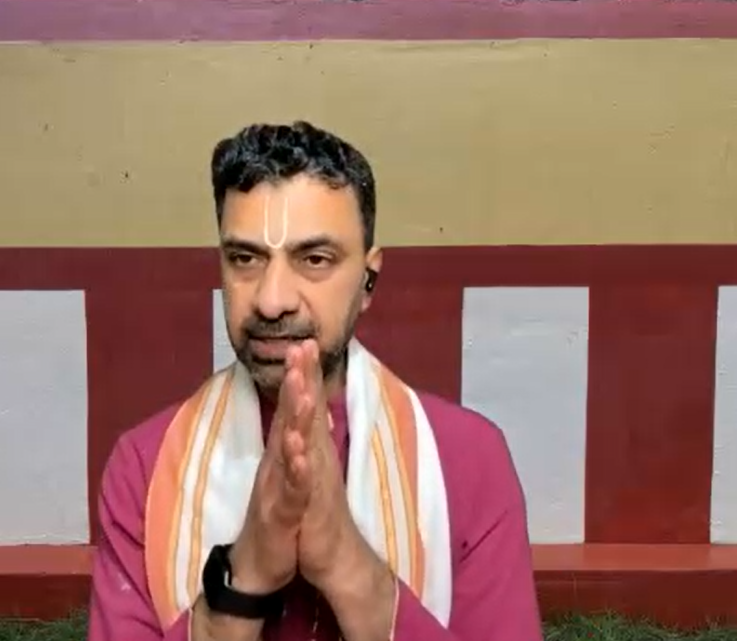
Based on the Yuva Sessions with Sri Ramanujamji
***************************************************************************************************************************************************
Click here to go back to October 2026 newsletter contents page:
 Every tradition asks how the divine enters the world, and Srimad Bhagavatam gives that question an entire chapter. In Canto 1, Chapter 3, Suta Goswami answers the sages’ request to describe Sri Krishna’s auspicious avataras. Sri Ramanujam Ji explained that avataras do not simply appear without reason. A real need has to meet the right moment, and that need must be a serious crisis of dharma, grave enough that sincere prayer calls divinity into the world. The Bhagavatam lists twenty-two avataras here, and eventually says that they are innumerable.