Rain falls equally on everyone. It does not choose where to fall or whom to bless. Yet, if one person keeps a small vessel outside, only a small amount of water can be collected. If another keeps a larger vessel, more water can be received. And if the vessel is kept upside down, not even a drop can be collected. The rain is the same; the difference lies in the vessel and how it is aligned to receive it.
Bhagavata Dharma, a part of our Vedic tradition, is centered on the mercy, compassion, and krupa, or grace, of Bhagavan. While many other paths rely heavily on personal effort and individual capacity, Bhagavata Dharma places greater emphasis on aligning ourselves to receive the grace that Bhagavan is constantly showering upon us.
It is not about trying to make Bhagavan bestow His grace upon us. His grace is already present and available to everyone. Like the rain, it is common to all. What we need to do is prepare ourselves to receive it. Just as a receiving antenna needs to be aligned towards the right satellite to receive its signal, we need to align ourselves towards Bhagavan. Bhagavata Dharma is therefore a path of alignment.
How do we align ourselves? We align our thoughts, speech, actions, and behaviours towards divinity. As we align ourselves, we become increasingly capable of receiving what is already being showered upon us. The focus is not on forcing grace to come to us, but on making ourselves receptive to it.
There are different ways of making a person follow the path of dharma. One approach is through fear and greed—the “carrot and stick” approach of reward and punishment. While this may make a person walk the path of dharma, it is often done grudgingly. The person may follow the rules, but may never become comfortable with oneself or enjoy the journey. There is another, greater path: to show the purpose and the values behind dharma, and the grandness of what we are capable of becoming. When we understand the “why,” the journey itself becomes joyful.
Bhagavatha Dharma takes this approach. It tells us that we are capable of immense love. Our wisdom is buried deep within us. Infinite love is already within us, waiting to flower. We can grow in love, goodness, and virtue by aligning ourselves with Bhagavan Sri Krishna.
This is the beauty of Bhagavata Dharma. It seeks inner transformation not through coercion or threat, but through radical acceptance and love. It does not ask us to first become perfect before we turn towards Bhagavan. Sri Krishna accepts us as we are. He is full of love, and He Himself longs for our love.
The path is therefore remarkably simple. Listen to Bhagavan Sri Krishna’s katha. Repeat His divine names. Speak about His glories and His beautiful qualities. Listen, sing, remember, and constantly speak about Bhagavan. Over time, the mind begins to turn towards Him. What we repeatedly think about begins to influence who we become. If our minds are constantly occupied with fear, worry, and negativity, these qualities can influence how we see ourselves and the world around us. But if we repeatedly contemplate a being filled with love, joy, beauty, compassion, and peace, those qualities begin to grow within us. So, as we think more and more about Sri Krishna and speak more and more about Sri Krishna, we will begin to imbibe His qualities. Love, compassion, acceptance, and devotion will gradually become part of our own nature.
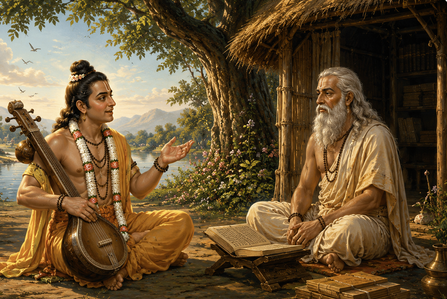
This is what Sri Narada Maharishi shows Sri Veda Vyasa. Sri Narada tells Sri Vyasa that wisdom is incomplete if it does not enable one to align with Bhagavan. The purpose of knowledge is therefore not merely to accumulate information, but to transform the individual. All that needs to be spoken about is the beauty, sweetness, and greatness of Bhagavan. When the mind is constantly exposed to these qualities, it naturally begins to move towards them.
Narada then shares his own story with Vyasa. The beauty of Bhagavata Dharma is that history does not matter. It does not matter who we were before, what circumstances we came from, or what we may have done in the past. Bhagavata Dharma gives us the opportunity to begin where we are. What matters is our association with those who already live Bhagavata Dharma.
Narada’s own transformation began through such association. As a young boy, he had the opportunity to serve and spend time with sadhus. The sadhus showed him krupa, not because of some extraordinary accomplishment, but because he continued to show up every day. Through their association and their prasada, the taste for bhagavatha dharma began to awaken within him.
This is the power of satsanga. Satsanga is not merely being physically present around spiritual people. It is an association that gradually makes our life divine and lighter. Through listening, serving, chanting nama, and repeatedly exposing ourselves to the lives and teachings of those who are established in Bhagavata Dharma, the mind and body become prepared for a higher experience. We may not immediately experience the result, but the preparation itself is transforming us.
The grace of a mahatma can rise in the heart in ways that we may not understand. Our role is to prepare ourselves. Nama, disciplined practice, satsanga, and the constant remembrance of Bhagavan prepare the body and mind so that, when the opportunity arises, the Guru can bless us with a divine experience.
Bhagavata Dharma therefore gives us a path of incredible acceptance and love and a direct and joyful path to inner transformation. It reminds us that our past does not define our future, that association can transform us, and that the constant remembrance of Bhagavan can align our thoughts, words, and deeds with divinity. Like Narada Maharishi, we too can begin simply by showing up, listening, serving, and associating with those who live this dharma.
Each one of us longs to be filled with love. Each one of us longs for joy and peace. Bhagavatha Dharma shows us that these qualities are not something distant from us. They are our own potential, waiting to flower. Bhagavan’s grace is already like the rain that falls upon us. All that remains is to turn our vessels in the right direction, open them fully, and become ready to receive the rain that has been falling all along.
Shwetha Srinivasan
Edmonton
Canada
**************************************************
Click here to go back to September 2026 newsletter contents page: