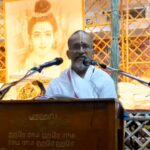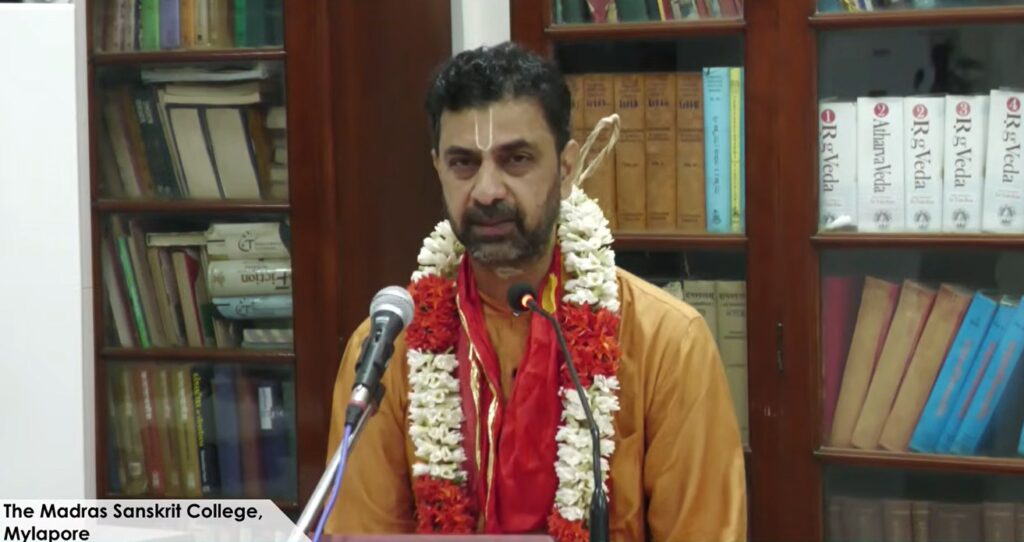
Sri Ramanujamji, in his recent discourse at Madras Sanskrit College (Mylapore) on the topic “Values from Srimad Ramayana”, beautifully highlighted how the life of Sri Rama exemplifies timeless human values that remain deeply relevant even today.
The Srimad Valmiki Ramayanam begins with Sage Valmiki’s inquiry to Narada Maharishi:
“kOn asmin sAmpradam loke guNavAn kascha vIryavAn …” –
“Who is the most righteous and perfect person in this world, endowed with all sixteen noble qualities?”
Narada Maharishi responds saying that it is Sri Rama of the Ikshvaku dynasty who embodies all these virtues. From these, Sri Ramanujamji in his discourse selected three key qualities—gratitude, acceptance, and empathy—and illustrated how they are profoundly reflected in Sri Rama’s life, while also emphasizing their relevance in this current day and age. He further stressed that gratitude is the root of all virtues, from which other qualities sprout. Only when gratitude is cultivated can one steadily walk the path of dharma with joy and stability. In this article we shall see each of these values in detail as shared by Sri Ramanujamji with some instances from Srimad Ramayana.
Gratitude
“dharmagnyashcha krutagnyashcha” — Sri Rama consistently demonstrated that for one who lives with gratitude, adherence to dharma becomes natural.
Gratitude is deeply woven into the fabric of Sanatana Dharma—first directed toward Bhagavan, then toward parents, sages, society, and every creation. In fact Sri Swamiji explains bhakti as an overpowering sense of gratitude towards Bhagavan for all His compassion and grace. Thus, gratitude becomes the foundation upon which all other virtues blossom.
Mahabharata talks of Pancha Maharuna — deva runa, pitru runa, rishi runa, manushya runa, and bhuta runa. These are not literal debts but a means of expressing our gratitude toward the gods, our ancestors who cared for us and guided our lives, sages who have blessed us with all the abundant knowledge to lead a dharmic life, fellow human beings, and mother nature and her inexhaustible resources. Our daily rituals, yagnas, and ancestral offerings are all expressions of this gratitude.
Acceptance
Sri Rama’s quality of acceptance is vividly seen when his coronation is suddenly cancelled and he is instead sent into exile for fourteen years.
In the Vishnu Sahasranama, the namavali ‘sumukhAyai namah’ is explained by Sri Adi Shankara Bhagavadpada through this very episode. ‘Sumukha’, in Sanskrit means auspicious, beautiful or pleasant-faced. Sri Ramachandra Prabhu rejoiced, hearing the news of the coronation. He was enthusiastic to righteously rule the kingdom, take care of his subjects and bring joy to his people. However the very next day, when he came to know that he had to leave for the forest, his face only brightened. His face continued to shine with equanimity, as he willingly embraced forest life with the same enthusiasm, ready to serve the sages and protect dharma.
Sri Sri Krishnapremi Swamigal, in Ramakathamrita Saram, praises this samatva guna—Sri Rama’s unwavering mental balance in all situations.
Whether in a city or forest, among kings or sages, humans or animals, Sri Rama remains equally content and composed. He demonstrates that when situations are not in one’s control, immediate acceptance of reality leads to inner stability. Going a step further Bhagavan Yogiramsuratkumar would say, “Whatever my father puts me through, not only will I accept it but also be grateful for it!”
Sri Ramanujamji also shared a practical insight from the Bhagavad Gita: feelings or emotions have a connection to what we call as justifiable needs. Emotions often arise from unmet needs. By becoming aware of the underlying need behind an emotion, one gains clarity and balance. He compared this to a fuel gauge in a vehicle—when it reaches “E,” the need is to refuel. Similarly, recognizing and addressing inner needs helps prevent emotional outbursts and keeps us stable.
Empathy
Sri Rama’s empathy is consistently evident throughout Srimad Ramayana. Even while himself enduring pain and agony, he remains deeply sensitive to the suffering of others—not only humans but all beings.
A striking example is the Jatayu Moksham episode. Jatayu, who valiantly tried to rescue Sita Matha from Ravana despite his old age, is fatally wounded. Sri Rama, upon finding him, does not see him merely as a bird but as a fatherly figure and elder of the family. Deeply moved, he performs Jatayu’s final rites and grants him liberation.
Another instance is from Kishkinda Kandam where Sri Rama meets the monkey-king Sugreeva. Sugreeva has lost his kingdom and wife and lives in constant terror of his brother Vali. Despite his own grief, Sri Rama patiently listens to Sugreeva’s repeated lamentations. Even when Sugreeva compares their situations, Sri Rama remains composed and understanding. Sugreeva failed to realize that he lost his kingdom but Bhagavan Sri Ramachandra Prabhu sacrificed the kingdom to uphold dharma. Unlike Sugreeva, Sri Rama is not in a hideout fearing his brothers; he is dutifully obeying the words of Kaikeyi matha. His suffering is rooted in sacrifice, not fear or helplessness. Yet he never dismisses Sugreeva’s pain.
Both Lakshmana Swami and Sri Hanumanji are aghast and pained seeing the kind of casual interaction Sugreeva has with Bhagavan. In spite of this Sri Rama offers an empathetic ear to Sugreeva. He reassures Sugreeva calmly and promises to help. He even demonstrates his power to instill confidence in Sugreeva, and finally wins over Vali and secures the kingdom for him. Even after this, he lets Sugreeva enjoy his newly-acquired kingdom and luxury for a few months before starting the search for Seetha Matha, despite his own deep anguish.
Through such instances, Sri Rama exemplifies empathy and prioritizes others’ well-being and happiness above his own.
Sri Ramanujamji concluded the lecture by encouraging all to reflect upon, internalize, and practice these values as living principles drawn from the life of Sri Rama.
Excerpt from Sri Ramanujamji’s lecture on Srimad Ramayana
Compiled by
Nithya Balasubramanian, Pleasanton, CA
Click here for the You Tube link of the actual discourse :
https://www.youtube.com/watch?v=oP5s-NKCYWU
**************************************************
Click here to go back to May 2026 newsletter contents page:
https://godivinity.org/newsletters/nama-dwaar-newsletter-may-2026/